
Discover how global investors are hedging against sticky inflation in 2026 using real assets and AI infrastructure.
Affiliate Disclosure: This post contains affiliate links. We may receive a commission if you make a purchase through these links at no extra cost to you. Our research remains independent and focused on providing high-quality insights. Enjoy the read and discover the 3 assets that could outperform inflation in 2026.
As we move through 2026, global investors face a landscape that challenges the traditional playbooks of the past decade.
While Artificial Intelligence continues to drive massive productivity gains and equity indices test new highs, a silent and persistent force is eroding purchasing power: sticky inflation.
What was once dismissed as a transitory post-pandemic surge has evolved into a more structural reality, fueled by geopolitical friction and the restructuring of global supply chains.
For investors seeking not just to survive but to thrive, the traditional “cash is king” strategy may represent one of the greatest portfolio risks.
Understanding how institutional investors, often referred to as “smart money”, are moving their money. is becoming a key factor in preserving real wealth rather than merely achieving nominal gains.
The New Macro Paradigm: Why Inflation May Remain Persistent.
According to projections from the International Monetary Fund, global economic growth has remained relatively resilient in recent outlooks, while inflation in major economies has been declining more slowly than expected.
The Fed’s Dilemma.
Officials at the Federal Reserve have repeatedly emphasized that inflation progress can be uneven.
Measures such as Core PCE (Fed’s gauge) the Fed’s preferred inflation gauge have remained above the central bank’s 2% target in recent years.
This persistence is not driven solely by demand. Trade frictions and supply-chain shifts are structural factors. These issues may continue to push prices higher.
In such an environment, assets with pricing power tend to attract greater investor interest.
INVESTOR’S BOX: Purchasing Power Erosion.
For example, if you hold. $100,000 in cash while inflation averages 3% per year, the real purchasing power of that money falls to roughly $86,000 after five years.
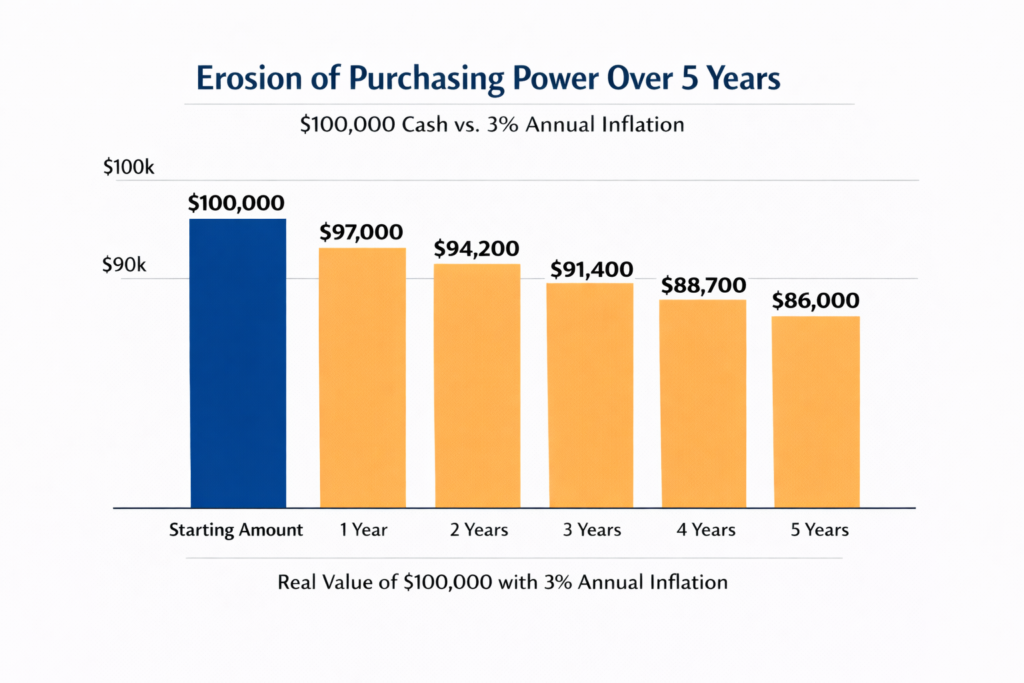
Even if the nominal balance does not change.
In a persistent-inflation environment, perceived “safety” can quietly erode wealth.
The Cash Fallacy: Lessons from Long-Term Market History.
There is psychological comfort in seeing a stable bank balance.
However, long-term financial research, including studies compiled in the Global Investment Returns Yearbook produced by UBS.
Showing that stocks have in the past outperformed both cash and bonds over long investment horizons.
The Mathematics of Erosion
Also, historically, global equities have generated a cash risk premium of several percentage points per year over long periods.
When inflation remains high and nominal cash returns barely offset inflation, especially after taxes, investors may experience a gradual loss of real purchasing power.
Institutional investors often treat liquidity as a tool for flexibility rather than a long-term store of value.
While high-quality bonds can provide stability during market stress, equities have historically been a major source of real long-term returns.
Understanding the behavioral side of wealth is as critical as the assets themselves. For those looking to master this mindset, The Psychology of Money continues to be an essential resource for navigating the 2026 economy.
The Active Shield: Where Institutional Capital Is Flowing.
Traditional passive Spread risk models, such as the classic 60/40 portfolio of stocks and bonds, have faced challenges during periods when asset classes move in the same direction.
As a result, many institutional investors are increasingly diversifying into real assets and strategic sectors.
The AI Buildout and Digital Infrastructure.
The AI revolution is no longer confined to software—it now requires massive Real assets .
Data centers and energy systems are now vital. They support the computing needs of the digital economy.
Infrastructure as a Safe Haven.
Major asset managers like BlackRock focus on digital real assets . These assets generate stable, long-term cash flows through contracts.
The Resurgence of Value Stocks.
Research and market outlooks from firms like Vanguard suggest that value stocks and international equities may offer diversification benefits after periods of strong growth-stock dominance.
Companies in sectors such as industrials, materials, and energy often possess tangible assets and pricing power, which can provide resilience during inflationary periods.
Geopolitics as a Profit Driver: The Global Supply Chain Reorganization
Global supply chains continue to evolve as companies seek resilience and geopolitical stability.
Regional Winners:
As companies diversify away from concentrated supply chains, several countries are attracting massive investment:
- Mexico: A primary hub for nearshoring to the U.S.
- Vietnam: A growing center for global tech manufacturing.
- Brazil: A key player in regional industrial reorganization.
The Tariff Effect:
Trade barriers and industrial policy can create short-term inflationary pressures, but they can also stimulate domestic investment in strategic sectors such as semiconductors, energy, and advanced manufacturing.
Institutional investors often follow large government spending initiatives and subsidies tied to national security, technology development, and industrial policy.
Conclusion: From Passive Preservation to Active Risk Management.
Protecting wealth in a higher-inflation world may require moving beyond passive assumptions about spread risk.
Broad indices can become concentrated in a small number of companies or sectors. As a result, many investors are increasingly focusing on intentional risk allocation.
Including exposure to real assets, real assets, alternative investments such as private credit, and companies with strong pricing power.
The defining skill for investors in the coming decade may not be avoiding volatility, but understanding how to use it as part of a strategy designed to preserve purchasing power.
FAQ:
1. What investments can help hedge inflation?
Assets with pricing power provide partial protection against inflation. This includes commodities, energy, and infrastructure assets.
2. What is “sticky inflation”?
Sticky inflation refers to inflation that declines slowly because structural factors, such as labor costs, energy prices, and supply-chain shifts,keep prices elevated even after demand weakens.
3. Why can holding cash be risky during inflation?
If the return on cash or savings accounts does not exceed inflation (after taxes and fees), the real purchasing power of that money gradually declines.
Technical Glossary:
Core PCE (Fed’s Gauge)
The inflation measure preferred by the Federal Reserve. It excludes volatile food and energy prices to highlight underlying inflation trends.
Real Return
The return on an investment after adjusting for inflation.
Smart Money
Capital controlled by institutional investors, large funds, and professional market participants.
Value Stocks
Shares of companies trading at relatively low valuations compared with fundamentals such as earnings, dividends, or assets.
For more information on global trends, explore our latest reports on HubTrendMix.
HubTrendMix is an independent research hub. The content provided here is for informational purposes only and does not constitute financial or investment advice. Always consult a qualified professional before making financial decisions.